
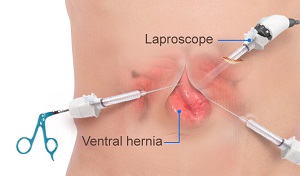
What is Complicated Hernia Surgery (Open & Laparoscopic)?
A hernia is a bulge or protrusion of an organ or fatty tissue through a weakened area in the muscle or connective tissue in which the organ is enclosed. A hernia can develop in any part of the body. However, the muscles of the abdominal wall are most commonly affected.
Complicated hernia surgery refers to the surgical management of hernias that are difficult to repair due to factors like size, recurrence, infection, bowel involvement, or poor tissue quality. These cases often require advanced techniques and specialised surgical expertise and are typically performed through open or laparoscopic techniques, depending on the complexity and patient-specific factors.
Indications for Complicated Hernia Surgery (Open & Laparoscopic)
Complicated hernia surgery is indicated when a hernia presents with additional risks or challenges that require urgent or specialised surgical intervention. These indications include:
- Incarceration – When the herniated tissue is trapped and cannot be manually pushed back into place.
- Strangulation – When the blood supply to the herniated tissue is compromised, leading to tissue necrosis.
- Recurrent Hernia – When a hernia returns after previous repair, often requiring a more complex approach.
- Large or Giant Hernia – When the defect is extensive, requiring abdominal wall reconstruction.
- Infection or Mesh Complication – When a prior synthetic mesh is infected or causing complications, requiring removal and alternative repair.
- Bowel Obstruction or Perforation – When the hernia involves the intestine, leading to obstruction or rupture.
- Multiple Comorbidities – When patients have conditions such as obesity, diabetes, or poor wound healing that complicate standard hernia repair.
Procedure for Complicated Hernia Surgery (Open & Laparoscopic)
Open Surgery
Open surgery is a traditional and effective approach for repairing complicated hernias, especially in cases where minimally invasive techniques may not be suitable. It involves making a larger incision over the hernia site to directly access and repair the defect typically under general anaesthesia. This method is often preferred for large, recurrent, infected, or strangulated hernias, as well as cases involving bowel involvement or loss of domain.
In general, open surgical repair may involve the following steps:
- A surgical incision is made to access the hernia sac and surrounding structures.
- If the hernia is incarcerated, trapped tissues are carefully released, and any strangulated bowel or necrotic tissue is removed if necessary.
- Depending on the case, the abdominal wall is repaired using sutures, mesh (synthetic or biologic), or component separation techniques for large defects.
- The incision is carefully closed, and drains may be placed to prevent fluid buildup.
Laparoscopic Surgery
Laparoscopic surgery is a minimally invasive approach used for complicated hernia repairs, offering benefits such as reduced post-operative pain, shorter hospital stays, and faster recovery. It involves making small incisions through which a camera (laparoscope) and specialised instruments are inserted to repair the hernia typically under general anaesthesia. This technique is particularly useful for recurrent hernias, incarcerated hernias without strangulation, and cases requiring extensive mesh placement while minimising surgical trauma.
In general, laparoscopic surgical repair may involve the following steps:
- Small incisions (typically 3-5) are made, and trocars (ports) are placed to allow instrument access.
- The herniated tissue is carefully released from the defect, and any adhesions are dissected.
- A synthetic or biologic mesh is placed either intraperitoneally or in the preperitoneal space to reinforce the abdominal wall.
- The mesh is secured with sutures, tacks, or glue, and the small incisions are closed.
Postoperative Care and Recovery
After complicated hernia surgery, patients are typically kept in the hospital for a few days, especially following open surgery, to manage pain, monitor for complications (such as infection or bleeding), and support bowel function. Pain management includes medications, and for open surgery, patients may require stronger analgesics due to the larger incision. Laparoscopic surgery generally results in less postoperative pain and a shorter hospital stay. Early mobilisation is encouraged to prevent complications like blood clots, and patients are often advised to avoid heavy lifting and strenuous activities for several weeks. Wound care, including keeping the incision clean and dry, is essential to prevent infection. Follow-up visits are scheduled to ensure proper healing and assess for any signs of hernia recurrence. Full recovery typically takes 3 to 4 weeks for laparoscopic procedures and up to a few months for open surgery, with a gradual return to normal activities based on the surgeon’s recommendations.
Risks and Complications
Both open and laparoscopic hernia repairs carry certain risks, especially when dealing with complicated cases. The complexity of the hernia or the patient’s health can increase the likelihood of complications. These risks include:
- Chronic pain
- Wound infection
- Abscess formation
- Mesh infection
- Recurrence of hernia
- Injury to surrounding structures
- Blood clots – deep vein thrombosis (DVT) or pulmonary embolism (PE)
- Seroma or hematoma formation
- Poor wound healing
If you wish to be advised on the most appropriate treatment, please call to schedule an appointment or click to request an appointment online.
